Brass Stamping – The Complete Beginner’s Guide in 2026
Brass Stamping is a vital process for creating exact, repeatable parts for electrical, automotive, hardware, and decorative uses. The knowledge of the process helps you select appropriate materials, tooling, design and production techniques. This guide covers the process, brass alloys, die options, design considerations, defects, finishes and applications. You will also gain insight into how prototype brass stamping can help to make better decisions before mass production. Last, but not least, you will learn about Masion, an integrated manufacturer that provides brass metal stamping and associated fabrication services.
What is brass stamping and how does it work?
Brass stamping is a stamping process that uses a press to push a punch onto a die with brass sheet. The punch is used to cut or form brass, typically at room temperature by cold forming. Single-station, compound or progressive dies can be selected depending on the production needs. This is an efficient method that makes thousands or millions of identical stamped brass parts. The evolution of stamping has moved from the use of hand tools to steam-powered equipment to modern mechanical presses. Servo presses today are used to provide precise control for demanding production applications. Small-scale hand stamping is, however, a practice of using letter punches and hammers for decorative impressions.
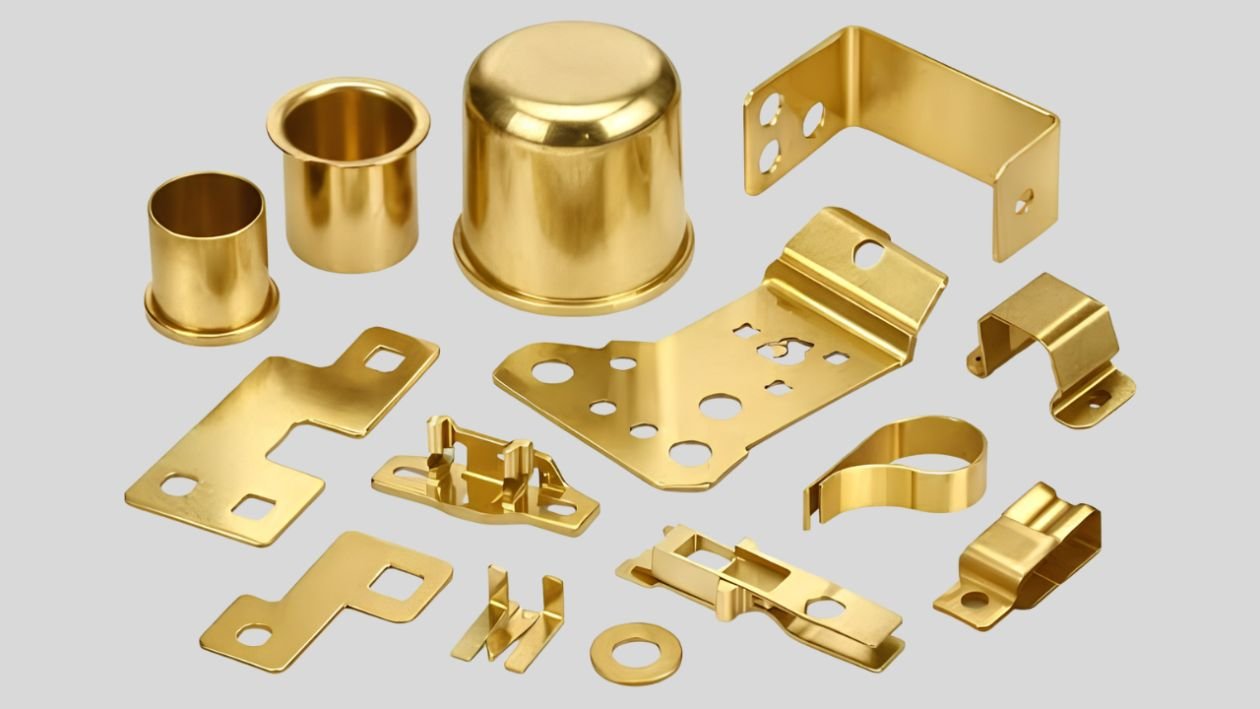
Why use brass for stamping? Key material advantages
Formability: Brass has good bendability, drawability and malleability. Because of its properties, it is easier to form brass into complex shapes than more difficult alloys. The annealed temper will also minimize the risk of cracking when deeper forming operations are used.
Conductivity: Brass is a good conductor of electricity and heat and is used for many applications. Its conductivity is lower than that of pure copper, but is appropriate for terminals, contacts and components for heat transfer.
Corrosion Resistance: Brass is corrosion resistant in a number of atmospheric and water environments. Dezincification-resistant alloys might be required in aggressive water or marine applications. Other dezincification protection can be achieved by the addition of tin or inhibitors.
Appearance and Finishing: Brass naturally gives finished parts an attractive gold look. It can be polished to improve its surface, or plated, lacquered or chemically colored for various finishes.
Recyclability: Brass stamping results in scrap which can be gathered and recycled. The material can be melted down and reused to create new brass products. This is beneficial for manufacturers to recycle useful material from manufacturing waste.
Low-Friction & Non-Sparking: Brass is a useful low-friction material for selected industrial uses. Its non-sparking properties make it suitable in some safety-sensitive applications. These properties can be utilized for components around potentially critical operating conditions.
Common brass alloys for stamping
Brass Stamping Grades are a combination of copper and zinc that are used to satisfy forming, strength, corrosion, conductivity and cost requirements. Increasing the concentration of copper makes the metal more ductile and resistant to corrosion, and increasing the concentration of zinc makes the metal stronger and potentially less expensive. ASTM B36/B36M-23 includes C26000 and C26800 for sheet, strip, plate, and rolled bar.
Alloy (UNS) | Approx. composition | Stamping relevance | Typical uses |
Cartridge brass (C26000, 70/30) | 70% Cu, 30% Zn | Excellent cold-working and deep-drawing properties | Hardware, casings, plumbing parts |
Yellow brass (C27000, 65/35) | 65% Cu, 35% Zn | Good strength and formability, cost-effective | Fasteners, rivets, general stampings |
Muntz metal (C28000, 60/40) | 60% Cu, 40% Zn | Stronger, less ductile, usually hot-worked | Architectural and marine parts |
Free-machining brass (C36000) | ~61.5% Cu, 35.5% Zn, ~3% Pb | Best for machining; limited cold-forming, so not ideal for severe forming | Machined fittings, valve parts |
Naval brass (C46400) | ~60% Cu, 39% Zn, 1% Sn | Tin improves seawater corrosion resistance | Marine hardware |
Annealed tempers are best for deep draws and tight bends; harder tempers offer stiffness and spring properties. Focus on bend rating, tensile strength, conductivity, finishing, plating, weldability, solderability and cost; RoHS rules may not allow for the use of leaded alloys.
The brass stamping process: Step-by-step
Step 1: Part design and DFM review
Start with part design and a DFM review before creating stamping tooling for production. Carefully examine bend radii, hole-to-edge distances, feature spacing and tolerances. These factors impact the forming performance, tooling complexity, dimensional consistency and production repeatability.
Step 2: Material selection and preparation
Choose the brass grade, temper and thickness based on part requirements. The thickness of stamped brass is usually between 0.1 mm and 3 mm. Ensure flat coil stock is free of visual surface defects prior to press feeding.
Step 3: Tooling design and build
Design, build and test tool steel dies in accordance with part geometry and sequence of production. Design the strip layout, die clearance, and springback compensation before machining. The typical clearance for a die is a small percentage of the material thickness, depending on the alloy and temper.
Step 4: Lubrication and setup
Install proper feeders, tooling, and lubrication equipment in the press. Lubrication will help to minimize friction between the brass and tooling during forming processes. Check feed alignment and press settings prior to production for consistent results.
Step 5: Stamping run
Operate processes based on the necessary part design and manufacturing sequence. Blanking involves cutting out the desired part shape, and piercing is the process of making holes in the workpiece with the aid of punches and dies. Bending creates angles through the manipulation of the brass with a controlled movement of the tools.
Step 6: Forming operations
Deep drawing is a process that moves brass into a die cavity to create a cup-like or recessed shape. The multi-stage deep draws may involve intermediate annealing between forming stages. Coining is a local compressive process, and embossing is a pattern-forming process without removing material.
Step 7: Secondary operations and inspection
Trimming is a process of cutting away unwanted material and creating final part boundaries. Additional operations, such as deburring, tumbling, annealing, plating, polishing or passivation, are performed as necessary. Perform first article inspection and in-process monitoring of dimensions to ensure the consistency of production quality.
Key brass stamping processes
Blanking and Punching/Piercing:
Blanking is used for cutting out the outer profile, and piercing is used for making holes and slots, which can cut the brass sheet accurately. For controlled cutting, the clearance is usually expressed as a percentage of the material thickness. Proper clearance will help control the burr height, which will enhance the quality of the edges and prevent problems involved in subsequent forming.

Bending and Flanging:
Brass can be bent to make angles, and flanged to make useful edges around formed sections consistently. Ensure the minimum bend radius is appropriate for the thickness of the material to minimize cracking. Avoid holes on bend lines and overbend as needed to allow for springback.

Drawing and Deep Drawing:
Efficiently convert flat brass blanks into cups, shells or casings. Brass has a tendency to work harden during the drawing process, which means that there is a limit to the extent to which each drawing stage can be taken before cracking. Intermediate annealing may be necessary to regain ductility for further forming in multi-stage drawing.

Coining and Embossing:
Coining and embossing are processes that are operated at high forming pressures to produce intricate brass features with precise detail. These processes are appropriate for fine details, logos, markings and flat features that need crisp definition. Sharp details with the desired surface geometry can be reproduced by controlled pressure and tooling.

Progressive, Transfer, and Compound Dies:
Progressive stamping is the process of passing a continuous brass strip through a series of stamping stations where cutting, forming or piercing is done. The strip will feed forward with each stroke, and the formed parts will exit continuously for high-volume production. There are two types of dies: compound dies are used for multiple operations on flat pieces in a single stroke, and transfer dies are used when larger or deeper parts are required, and the blanks are moved between stations.

Prototype brass stamping: Validating designs before mass production
Prototype brass stamping is available to verify fit, function and formability prior to investing in hardened progressive tooling. Laser or water jet cut blanks can be used with press brake forming, soft tooling and short run dies. Due to the variation in grain direction and burr side, prototypes may not act the same as production parts. Use the production alloy and temper to test prototypes for more reliable results. This reduces costs up-front, accelerates design iterations, and offers early DFM feedback prior to production tooling.

Design guidelines for stamped brass parts
In the stamped brass parts design, please refer to these points and verify with the stamper:
- Generally, the hole diameter should be at least as large as the material thickness.
- Maintain a distance of several material thicknesses from bend lines and edges to holes and slots.
- Avoid inside bend radii of less than approximately 1x thickness (higher for harder tempers).
- Make relief cuts at bend corners and eliminate sharp corners inside the house.
- For critical bends, indicate grain direction.
- Tolerances: Only specify where they are functionally required.
Be aware of season cracking, which is a problem of cracking of brass in an ammoniacal environment under the influence of residual stress. This can be avoided by a stress-relief anneal. Get your stamper on board early for practical DFM advice.
Common brass stamping defects and how to prevent them
Burrs: Burrs can be created during stamping if there is too much or not enough clearance. Similar defects can result from a worn die. Adjust the clearance and sharpen or maintain the die regularly.
Springback: Brass will spring back after forming, and this will influence the shape of the final product. This recovery can be compensated for, and dimensional accuracy improved, by overbending or restriking.
Cracking or Tearing: Hard-temper brass or too aggressive a draw can result in cracks. Reduce forming stress by use of annealed stock, draw stages and better lubrication.
Wrinkling: If the blank-holder force is not sufficient, the material may buckle during drawing. The higher the holding force, the more the material flow will be controlled, and unwanted wrinkles will be reduced.
Scratches, Galling & Inspection: Rough die surfaces and poor lubrication can cause scratches on stamped brass surfaces. Utilize clean lubricant, polished tooling and protectives as required. First article checks, go/no-go gauges or optical inspection should be performed during in-process inspection.
Surface finishing options
There are a number of finishes available, depending on the purpose of the part, its environment, and desired appearance. Deburring and tumbling smooth edges, and polishing enhances surface appearance and cleanliness. Corrosion protection, contact reliability and solderability are provided by nickel or tin plating. Gold or silver plating is good for electronics, and chrome enhances durability and looks. Clear lacquer provides protection while chemical coloring and patination provide a controlled decorative finish.
Applications of brass stamping across industries
Electronics and Electrical: Brass is used for terminals, connectors, battery contacts, lead frames and grounding clips. It has conductivity that allows for dependable electrical contacts and current transfer.

Automotive Industry: Brass is used to make trim, connectors, fittings and sensor components in the automotive industry. It resists corrosion and is formable, which aids long-lasting components with exact specifications.

Plumbing and Hardware: Brass is used for fittings, hinges, handles, locks and lighting items. These parts are resistant to corrosion, ensuring their reliability in challenging conditions.

Medical and Instrumentation: Brass is used for small precision parts and electrical contacts. It is formable to create intricate shapes and conductive for contact applications where reliable connections are essential.

Decorative and Consumer: Stamped brass parts are jewelry findings, badges, tags, and parts for musical instruments. Brass has a pleasing look and is simple to create designs.

Masion: Brass metal stamping services with integrated manufacturing
Masion is a sheet metal fabrication manufacturer with integrated production since 2007 in Ningbo, China. It has 400+ employees who support stamping, laser cutting, CNC punching, bending, welding, riveting, assembly and finishing. This integrated setup minimizes the number of handoffs and improves quality control of brass stampings. DFM support, prototyping, inspection and contract manufacturing are also available for custom projects. Masion’s products are used in automotive, electronics, medical, robotics, energy, construction and industrial automation. The factory area provided is 30,000 m³ – check if this should be 30,000 m² before publishing. When you are looking for brass metal stamping services, inquire about the experience they have with brass, tooling and secondary finishing.

Conclusion
Brass stamping is a perfect mix of brass formability, conductivity, corrosion resistance, and efficient and repeatable production. Choosing the proper alloy, temper, tooling, and process control for the part is critical to success. Common defects and inconsistencies can also be avoided with proper design and inspection. For brass stamping products such as terminals or decorative parts, the earlier the DFM guidance, the better. When you’re looking to request a quote, be sure to check with a seasoned stamping partner such as Masion to ensure that your design, materials, tooling, and production volumes are considered.
FAQs
What makes brass stampings suitable for tight tolerances?
Brass is ductile, has low springback and dimensional stability, and is clean and easily stamped for precise dimensions. A good die clearance and tooling will maintain dimensions and reduce distortion during forming processes. Masion is able to support DFM, prototyping, inspection and integrated stamping for controlled custom production.
When is brass metal stamping better than CNC machining?
Brass stamping is a process that is ideal for producing shapes in a short time with a low unit cost, and is suitable for stamping many thin and repeated parts. It’s also very efficient with sheet material for simple two-dimensional or shallow 3D profiles. CNC machining is still the best choice for prototypes, thick blocks, deep pockets, threads or complex shapes.
How does stamping brass affect material strength?
Cold stamping is a method of work hardening brass because it limits the movement of dislocations in the crystal lattice of the metal during the deformation process. This enhances tensile strength and hardness and decreases ductility in heavily formed areas. The mechanical properties after stamping are dependent on the starting temper, zinc content, and localized deformation.
What factors affect accuracy when shaping brass?
Shaping accuracy is affected by alloy composition, sharpness of tools, wear of tools, cutting parameters, stability of the machine and temperature. Dimensional drift, rubbing and rough finishes can be prevented by using the correct speeds, feeds and cutting depths. The combination of fabrication and inspection features of Masion can help make process control easier for custom brass parts.
How precise is progressive stamping brass for small components?
Typical tolerances for progressive brass stamping, under controlled production, are in the region of plus or minus 0.001 inch. If the tolerances are kept under close control, tighter tolerances can be achieved when the tooling, alignment, material control and inspection are carefully optimized. Pilot pins precisely position the strips between stations, and the carrier strips ensure repeatable positioning from successive operations. Masion provides tooling, prototyping, inspection and secondary processes for small brass parts.